Introduction
When it comes to selecting a hydraulic oil cooler, one of the first and most important decisions is choosing between an air-cooled or water-cooled design. Both types accomplish the same fundamental goal — removing excess heat from hydraulic fluid — but they do so in very different ways, each with its own set of advantages, limitations, and ideal applications. Understanding the differences can help you make a more informed decision and avoid costly mismatches between your equipment and cooling system.
How Air-Cooled Hydraulic Oil Coolers Work
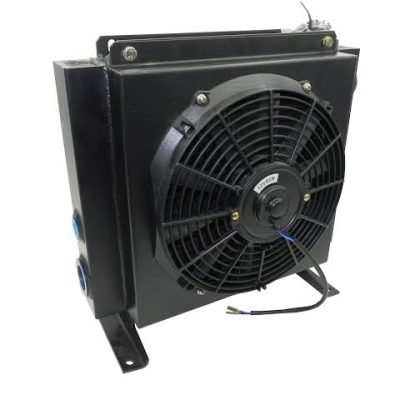
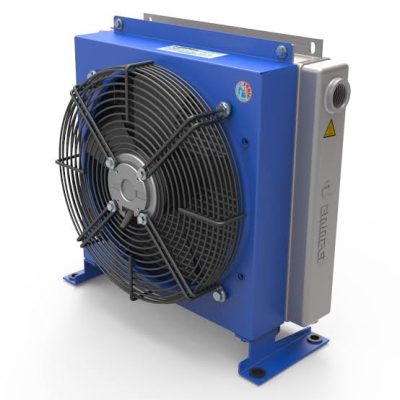
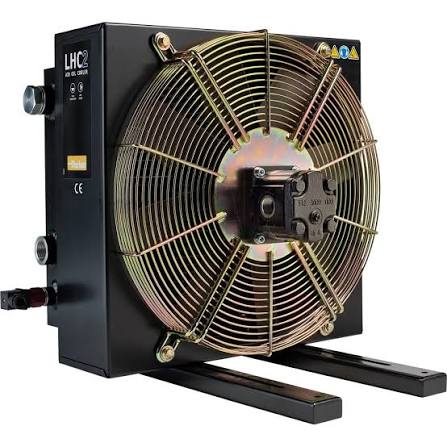
An air-cooled hydraulic oil cooler uses a fan to push or pull ambient air across a finned tube or bar-and-plate core through which hot hydraulic fluid flows. As air passes over the fins, it absorbs heat from the oil, and the cooled fluid is returned to the hydraulic system. This design is self-contained and doesn’t require any external water source, making it a popular choice for a wide range of equipment.
Advantages of Air-Cooled Coolers
- No water source required — ideal for mobile and remote equipment
- Simple installation — fewer plumbing connections needed
- Lower long-term maintenance — no risk of water scaling or corrosion
- Widely available — common in construction, agriculture, and mobile hydraulics
Disadvantages of Air-Cooled Coolers
- Performance drops in hot climates — less effective when ambient air temperature is high
- Larger footprint — generally bulkier than water-cooled equivalents for the same cooling capacity
- Fan noise — can be a consideration in noise-sensitive environments
- Dust and debris sensitivity — fins can become clogged, reducing efficiency over time
How Water-Cooled Hydraulic Oil Coolers Work
A water-cooled hydraulic oil cooler uses a shell-and-tube or plate heat exchanger design, where cool water flows through one set of channels while hot hydraulic oil flows through another. Heat transfers from the oil to the water, which then carries it away, either to a drain, cooling tower, or recirculating chiller system.
Advantages of Water-Cooled Coolers
- More efficient heat transfer — water has a higher heat capacity than air
- Compact design — smaller footprint for the same cooling capacity
- Consistent performance — less affected by ambient air temperature
- Quieter operation — no fan noise involved
Disadvantages of Water-Cooled Coolers
- Requires a water source — not practical for mobile or remote equipment
- Plumbing infrastructure needed — additional installation complexity
- Scaling and corrosion risk — water quality must be monitored and maintained
- Water usage and disposal considerations — may involve additional costs or environmental regulations
Side-by-Side Comparison
| Factor | Air-Cooled | Water-Cooled |
|---|---|---|
| Water source needed | No | Yes |
| Footprint | Larger | Smaller |
| Best for | Mobile/remote equipment | Stationary industrial systems |
| Maintenance focus | Fin cleaning | Scale/corrosion prevention |
| Ambient temperature sensitivity | High | Low |
| Noise level | Higher (fan) | Lower |
| Installation complexity | Simpler | More involved (plumbing) |
Which Applications Favor Air-Cooled Coolers?
Air-cooled hydraulic oil coolers tend to be the better choice for:
- Construction equipment — excavators, loaders, cranes operating on job sites without water access
- Agricultural machinery — tractors and combines working in fields
- Mobile hydraulic units — truck-mounted equipment and portable power packs
- Remote installations — locations where plumbing infrastructure isn’t feasible
Because these applications typically operate outdoors and away from fixed water supplies, the self-contained nature of an air-cooled system makes it the practical choice.
Which Applications Favor Water-Cooled Coolers?
Water-cooled hydraulic oil coolers are generally better suited for:
- Indoor manufacturing facilities — injection molding machines, industrial presses
- Marine hydraulic systems — where seawater or freshwater cooling loops are already in place
- Space-constrained installations — where a compact footprint is a priority
- High-heat-load applications — where superior heat transfer efficiency is needed
These settings typically already have water infrastructure available, making water cooling a natural and efficient fit.
Cost Considerations
Initial purchase price can vary depending on size and capacity, but it’s important to consider the total cost of ownership. Air-cooled units may have lower installation costs but can consume more energy running fans continuously, especially in hot environments. Water-cooled units may have higher upfront installation costs due to plumbing requirements but can offer better long-term efficiency in the right setting. Ongoing maintenance costs should also factor into your decision — fin cleaning versus water treatment and scale prevention.
Hybrid and Alternative Options
In some cases, manufacturers offer hybrid systems or specialized designs that combine elements of both approaches, such as closed-loop systems with radiators that mimic water cooling without requiring an external water source. These can be worth exploring if you need the efficiency of water cooling without the infrastructure requirements.
Making Your Final Decision
To choose between air-cooled and water-cooled hydraulic oil coolers, ask yourself:
- Is my equipment mobile or stationary?
- Do I have access to a reliable water source?
- What are my typical ambient operating temperatures?
- How much space do I have for installation?
- What’s my budget for both installation and ongoing maintenance?
Answering these questions honestly will point you toward the right solution for your specific application.
Shopping Tips
When comparing a hydraulic oil cooler online, make sure listings clearly specify whether the unit is air-cooled or water-cooled, along with detailed performance specifications such as heat dissipation rate, flow capacity, and pressure rating. Don’t hesitate to reach out to suppliers with questions about your specific application if the listed specifications aren’t clear.
Conclusion
Both air-cooled and water-cooled hydraulic oil coolers are effective solutions for managing hydraulic fluid temperature, but the right choice depends heavily on your equipment type, operating environment, and available infrastructure. Mobile and remote applications generally favor air-cooled units, while stationary industrial systems with access to water often benefit from the efficiency and compact design of water-cooled coolers. By carefully evaluating your specific needs, you can select a hydraulic oil cooler that delivers reliable performance and long-term value.